

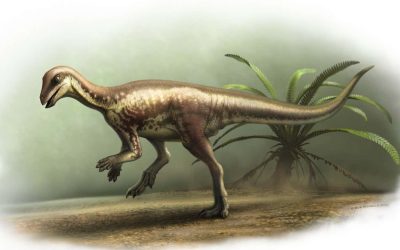
Enigmacursor mollyborthwickae: Small and speedy dinosaur recognised as a new species

Illustration of Enigmacursor mollyborthwickae, a newly recognised dinosaur species Bob Nicholls Art A newly discovered species of dinosaur is going on display in London’s Natural History Museum. Enigmacursor mollyborthwickae was a speedy, two-legged herbivore, 64 centimetres tall and 180 cm long that lived about 145 million to 150 million years ago, during the Late Jurassic…

Read More

Natural History Museum to display rare dog-sized dinosaur

Georgina Rannard Science correspondent Reporting fromNatural History Museum, London Gwyndaf Hughes/BBC News The full name of the new species is Enigmacursor mollyborthwickae dinosaur Gwyndaf Hughes Science videographer A labrador-sized dinosaur was wrongly categorised when it was found and is actually a new species, scientists have discovered. Its new name is Enigmacursor – meaning puzzling runner…

Read More

COVID-19 protein triggers immune attacks on healthy cells — but a common drug can stop it

A new study reveals that the SARS-CoV-2 nucleocapsid protein can spread from infected to uninfected cells, triggering an immune response that mistakenly targets healthy cells. The research identifies how this viral protein binds to cell surfaces and shows that enoxaparin, a common anticoagulant, can block this harmful interaction, pointing to a potential avenue for treatment….

Read More

Ancient carbon ‘burps’ caused ocean oxygen crashes — and we’re repeating the mistake

New research from the University of California, Davis, the Chinese Academy of Sciences and Texas A&M University reveals that massive emissions, or burps, of carbon dioxide from natural earth systems led to significant decreases in ocean oxygen concentrations some 300 million years ago. Combining geochemical analyses of sediment cores and advanced climate modeling, the study,…

Read More

How brain cells meant to help may be making depression worse

Major depressive disorder (MDD) is a mental health condition that negatively affects the mood of a person and causes a loss of interest in activities that were previously associated with happiness. In addition to cognitive impairments and forgetfulness, MDD can significantly affect social and occupational areas of functioning. Studies investigating the pathophysiology of MDD indicate…

Read More