


Key Takeaways
- In September, HHS Secretary Robert F. Kennedy Jr. and FDA Commissioner Marty Makary announced in a letter to Republican lawmakers that the FDA would conduct a safety review of mifepristone, the abortion pill, twenty-five years after it was first approved for use. Public awareness of the pill and its longstanding safety record is limited. About half (53%) of the public have heard of mifepristone and few (24%) are aware that it accounts for the method of most abortions in the U.S. today.
- While the public is much more likely to say abortion pills are safe (42%) when taken as directed than unsafe (18%), four in ten say they are not sure about mifepristone’s safety. Results are similar among women of reproductive age (18 to 49), with about four in ten (41%) viewing the pills as safe, one in five (21%) saying they are unsafe, and 37% saying they are not sure. Notably, public perception of the pills’ safety has dropped since 2023, when 55% of the public said abortion pills were safe when taken as directed, 9% viewed them as unsafe, and 35% were not sure.
- Most of the public opposes policies that would restrict access to the abortion pill. At least two-thirds of adults, including majorities of Democrats and independents, say they oppose banning the use of mifepristone nationwide (68%) or making it a crime for health care providers to mail abortion pills to patients in states where abortion is banned (65%). Republicans are split, with about half saying they support each of these laws, while MAGA supporting Republicans are slightly more likely to say they support than oppose making it a crime for health care providers to mail abortion pills to states where abortion is banned.
- The tax and spending bill passed by Congress and signed into law by President Trump in July ended Medicaid payments for services other than abortions to clinics that provide abortions, such as Planned Parenthood. These non-abortion related services include preventive care, STI treatment, and contraceptives. The latest KFF Health Tracking Poll shows that most (65%) of the public oppose banning these clinics from receiving Medicaid payments, while about one-third (35%) support it. Most Democrats (83%) and independents (65%) oppose a ban, while Republicans are split with 55% supporting it and 45% opposing it. MAGA-supporters are more likely to support (58%) than oppose (42%) this policy.
Fewer than Half of the Public Are Aware of Mifepristone Prevalence and Safety
About half (53%) of the public say they have heard of mifepristone, one of the two medications used in most abortions in the U.S., including just over half (56%) of women of reproductive age (ages 18 to 49). Public awareness of mifepristone has increased over the years as it has become the focal point for lawsuits following the overturning of Roe v. Wade. However, the public is still largely unaware that most abortions in the U.S. are done by taking abortion pills. About one in four (24%) adults correctly say that most abortions in the U.S. are medication abortions, while three in ten (29%) incorrectly believe that most abortions are done procedurally, and nearly half (47%) say they are not sure.
Larger shares of women of reproductive age, Democrats, and adults who identify as “pro-choice” are aware that most abortions in the U.S. are performed using abortion pills, but about one-third or fewer of each of these groups are aware of this. In fact, at least four in ten adults across key demographic groups say they are “not sure” how most abortions in the U.S. are conducted.

The public is also largely unaware of the medication’s long-established safety record. Twenty-five years of mifepristone’s availability in the U.S. has shown the medication is safe when taken as directed by a doctor or other health care provider. However, the latest polling from KFF shows that the public is not entirely aware of this. While more than twice as many adults say the medication is “safe” (42%) than say it is “unsafe” (18%), an additional four in ten adults are not sure. The results are similar among women of reproductive age, with about four in ten saying abortion pills are safe (41%), about one in five (21%) saying they are unsafe, and nearly four in ten (37%) saying they are not sure.
Perceptions of the safety of mifepristone safety diverge by partisanship. Nearly two-thirds (63%) of Democrats say medication abortion pills are at least “somewhat” safe compared to four in ten independents and just a quarter of Republicans (26%). Larger shares of Republicans (47%) and independents (44%) compared to Democrats (26%) say that they are “not sure” whether abortion pills are safe.
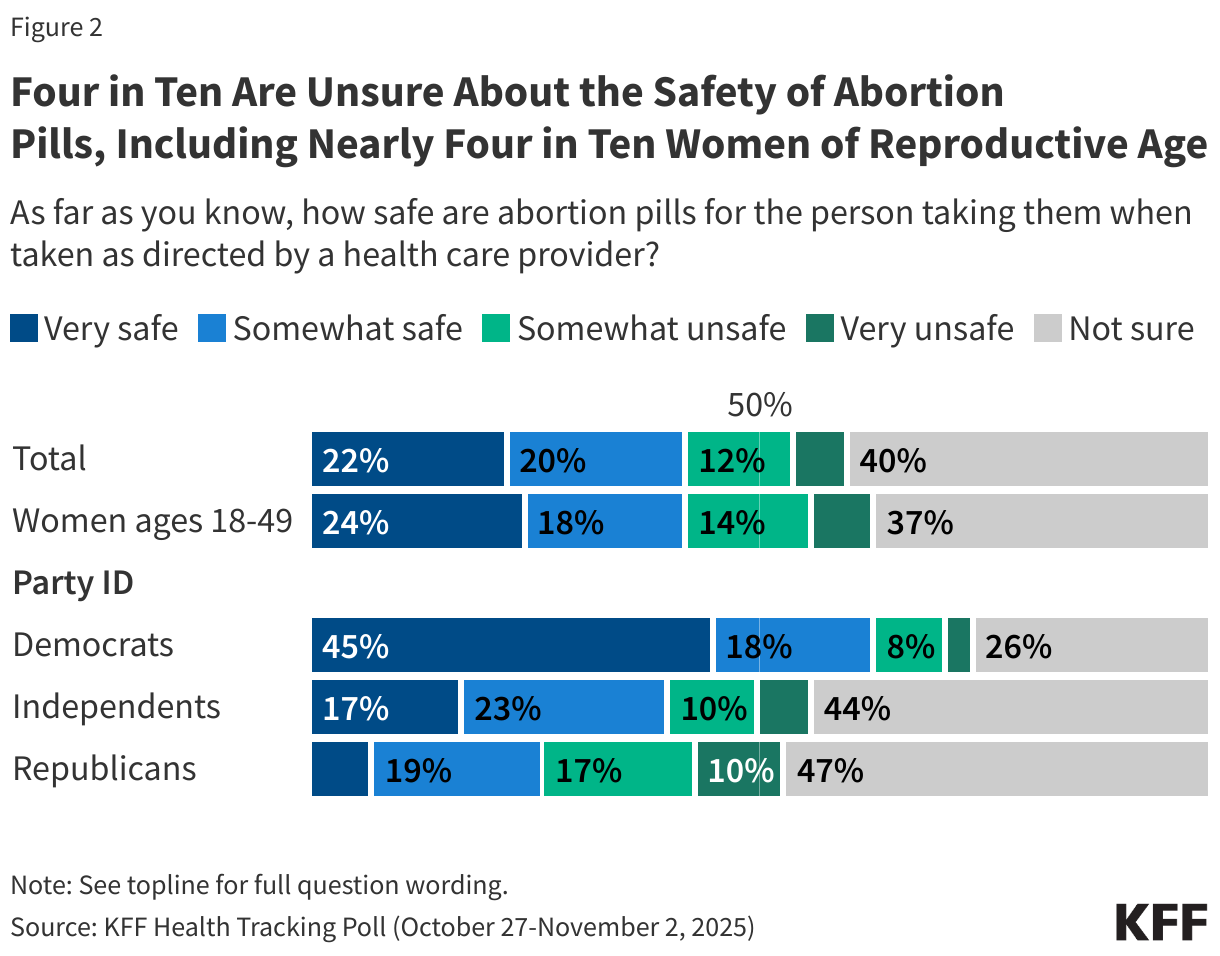
While a plurality of adults view abortion pills as very or somewhat safe when taken as directed by a health care provider, this share has declined since May 2023. About four in ten (42%) now say that abortion pills are safe when taken as directed, compared to a majority (55%) two years ago. At the same time, there have been slight increases in the shares saying abortion pills are “unsafe” (18% now, up from 9% in 2023) and that they are “not sure” (40% now, up from 35% in 2023).
Similarly, among women of reproductive age, the share viewing the pills as safe decreased from 59% to 41%, while larger shares now view the pills as unsafe (from 12% in 2023 to 21% now) or say they are not sure if abortion pills are safe (from 29% to 37% now).

Perceptions of safety are somewhat higher when the public is told that the FDA has determined the medication is safe when taken as directed by a health care provider. Just over half of the public (54%) – including a similar share of women of reproductive age – say they are confident in the FDA’s determination that mifepristone is safe, while about a quarter are “not too” or “not at all confident” (27%) and one in five are unsure (19%).
Confidence in the FDA’s determination of mifepristone’s safety is largely partisan. About three-quarters (74%) of Democrats and just over half (55%) of independents are at least somewhat confident in the FDA’s determination that mifepristone is safe when taken as directed by a health care provider, compared to about one-third (35%) of Republicans. Just under half (46%) of Republicans say they are “not too” or “not at all confident” in the FDA’s determination, and about one in five say they are not sure.

Public Awareness of Recent FDA Review of Mifepristone Is Low
In late September, HHS Secretary Kennedy and FDA Commissioner Makary wrote a letter to Republican state attorneys general announcing a review of mifepristone’s safety by the FDA. They cited the need to examine alleged complications and policies related to dispensing mifepristone, a move prompted by a flawed report from an anti-abortion advocacy group questioning the pill’s safety.
Most of the public say they have heard “a little” (27%) or “nothing at all” (47%) about this move from Secretary Kennedy and the FDA. One in five adults have heard “some,” and few (6%) report hearing “a lot.” Democrats are more likely than independents or Republicans to say they have heard at least “some” about this decision, but at least two-thirds across partisans report hearing little or nothing about it.

Once they are made aware of Secretary Kennedy’s decision to have the FDA review the safety of mifepristone, the public is split in assessing its intention, with just over half saying it is mostly to make it more difficult to access abortion pills (53%), and slightly fewer saying it is mostly to protect the health and safety of women (46%). Just over half (54%) of women of reproductive age say that the review of the safety of mifepristone is mostly to make abortion pill access more difficult.
Partisans have very different assessments of the intention behind this review. Eight in ten Democrats (81%) say the move is mostly intended to make access to abortion pills more difficult, while about three in four Republicans (73%) say it is mostly to protect the safety of women. Independents are split with about half saying the move is to make access more difficult (53%), and half (46%) saying it is to protect the safety of women.

A Majority of the Public Oppose Policy Proposals Aimed at Restricting Medication Abortion Access
Overall, at least two thirds of the public oppose policies aimed at restricting or banning medication abortion asked about in this survey. This includes two-thirds of adults who oppose banning the use of medication abortion, nationwide (68%) and a similar share who oppose making it a crime for health care providers to mail abortion pills to patients in states where abortion is banned (65%).
Support for these proposals varies by partisanship, with large shares of Democrats and independents opposed and Republicans more evenly split. A slim majority of Republicans support making it a crime for health care providers to mail abortion pills to patients in states where abortion is banned (55%), while about four in ten (44%) oppose this. Among Republicans, similar shares support (52%) or oppose (46%) banning mifepristone nationwide.
Republican and Republican-leaning supporters of the Make America Great Again (MAGA) movement are also split, with half saying they support banning mifepristone nationwide (50%) and half opposing this (48%). When it comes to mailing abortion pills to patients in states where abortion is banned, MAGA-supporting Republicans are more likely to say they support (58%) criminalizing health care providers than they are to oppose this (41%).

Most of the Public Oppose the Medicaid Funding Ban on Clinics that also Provide Abortions
In July 2025, President Trump signed a spending law that ended federal Medicaid reimbursement to certain clinics for services they provide to patients if the clinics also offer abortions. Abortions, however, were and are not paid for using federal Medicaid funds other than the Hyde Amendment exceptions for pregnancies that are life threatening or result from rape or incest. The law blocks federal reimbursements for other services, including preventive care, contraceptives, and STI treatment. Some states have redirected their own funds to compensate for the loss of these federal reimbursements, and at least twenty Planned Parenthood clinics have closed since the law took effect in July 2025.
About two-thirds (65%) of the public oppose the current law banning clinics that provide abortions from receiving federal Medicaid payments for other services they provide, while about one-third (35%) support this.
Partisans are split on this, with majorities of Democrats (83%) and independents (65%) opposing banning clinics from receiving these funds, while Republicans are more divided. Just over half (55%) of Republicans say they support a law banning clinics that provide abortions from receiving Medicaid payments for other services, while 45% oppose this. MAGA-supporting Republicans and Republican-leaning independents are more likely to support this ban (58%) than oppose it (42%).