


This post was written with Arun Sittampalam and Maxime Darcot from Swisscom.
As we navigate the constantly shifting AI ecosystem, enterprises face challenges in translating AI’s potential into scalable, production-ready solutions. Swisscom, Switzerland’s leading telecommunications provider with an estimated $19B revenue (2025) and over $37B Market capitalization as of June 2025 exemplifies how organizations can successfully navigate this complexity while maintaining their commitment to sustainability and excellence.
Swisscom has been recognized as the Most Sustainable Company in the Telecom industry for 3 consecutive years by World Finance magazine, Swisscom has established itself as an innovation leader committed to achieving net-zero greenhouse gas emissions by 2035 in alignment with the Paris Climate Agreement. This sustainability-first approach extends to their AI strategy where they’re breaking through what they call the “automation ceiling” – where traditional automation approaches fail to meet modern business demands.
In this post, we’ll show how Swisscom implemented Amazon Bedrock AgentCore to build and scale their enterprise AI agents for customer support and sales operations. As an early adopter of Amazon Bedrock in the AWS Europe Region (Zurich), Swisscom leads in enterprise AI implementation with their Chatbot Builder system and various AI initiatives. Their successful deployments include Conversational AI powered by Rasa and fine-tuned LLMs on Amazon SageMaker, and the Swisscom Swisscom myAI assistant, built to meet Swiss data protection standards.
Solution overview: Swisscom’s agentic AI enabler framework
The challenge of enterprise-wide scaling of AI agents lies in managing siloed agentic solutions while facilitating cross-departmental coordination. Swisscom addresses this through Model Context Protocol (MCP) servers and the Agent2Agent protocol (A2A), for seamless agent communication across domains. Operating under Switzerland’s strict data protection laws, they’ve developed a framework that balances compliance requirements with efficient scaling capabilities, helping prevent redundant efforts while maintaining high security standards.
Swisscom’s multi-agent architecture: System design and implementation challenges
Swisscom’s vision for enterprise-level agentic AI focuses on addressing fundamental challenges that organizations face when scaling AI solutions. They recognise that successful implementation requires more than just innovative technology, it demands a comprehensive approach to infrastructure and operations. One of the key challenges lies in orchestrating AI agents across different departments and systems while maintaining security and efficiency.
To illustrate these challenges in practice, let’s examine a common customer service scenario where an agent is tasked with helping a customer restore their Internet router connectivity. There are three potential causes for the connectivity loss: 1) a billing issue, 2) a network outage, or 3) a configuration mismatch known as a pairing issue. These issues typically reside in departments different from where the assigned agent operates, highlighting the need for seamless cross-departmental coordination.
The architecture diagram below illustrates the vision and associated challenges for a generic customer agent without the Amazon Bedrock AgentCore. The shared VPC setup of Swisscom is explained in more detail in the blog post, Automated networking with shared VPCs at Swisscom.
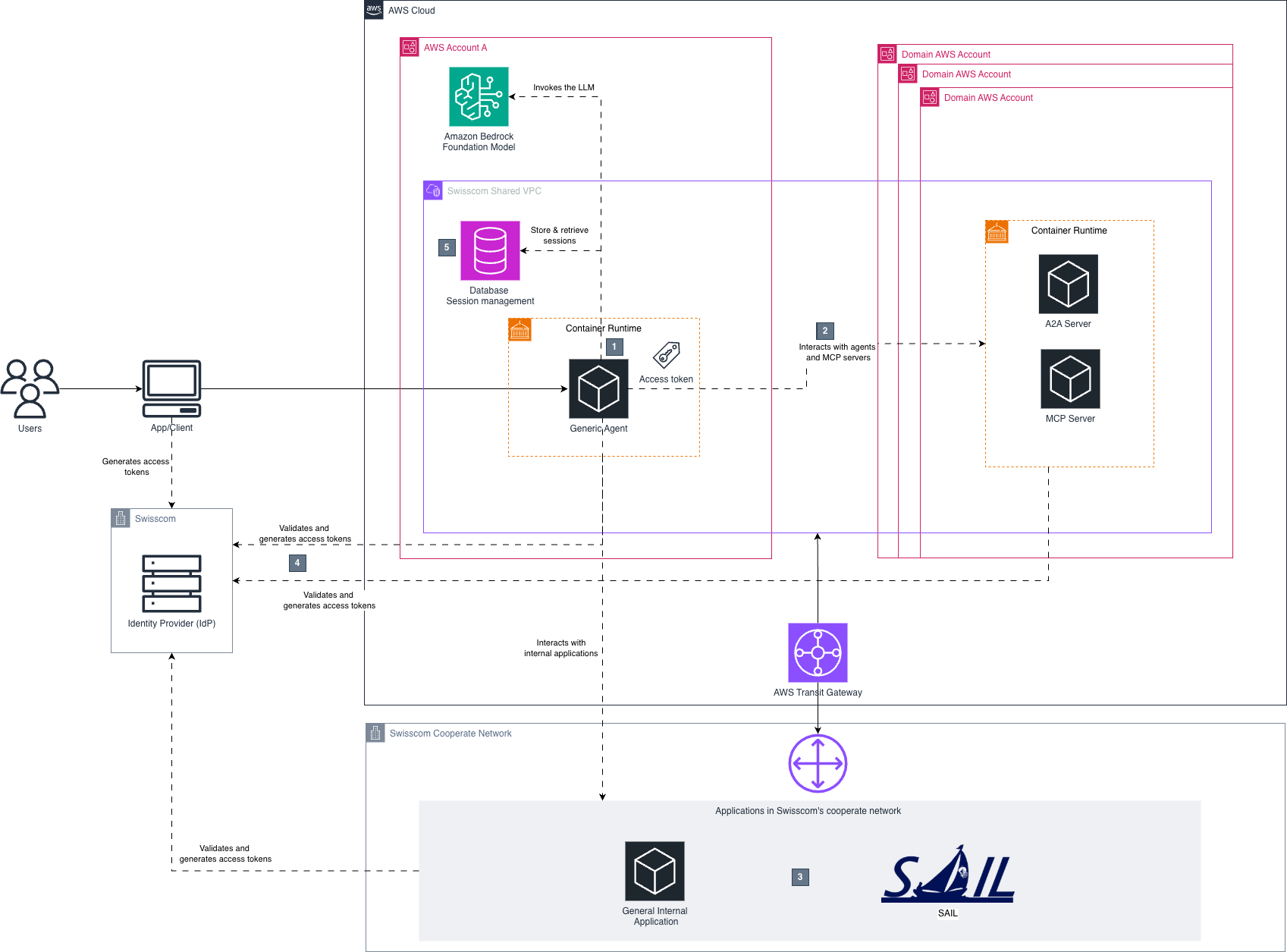
This architecture includes the following components:
- A customer-facing generic agent deployed as a containerized runtime within a shared VPC, requiring both foundation model invocation capabilities and robust session management.
- For task completion, the agent requires to access to other agents and MCP servers. These resources are typically distributed across multiple AWS accounts and are deployed as containerised runtimes within the shared VPC.
- Internal application access primarily occurs through SAIL (Service and Interface Library), Swisscom’s central system for API hosting and service integration. Corporate network resources are accessible via AWS Direct Connect, with a VPC Transit Gateway facilitating secure cross-network communication.
- Security compliance is paramount: each interaction requires temporary access tokens that authenticate both the agent and the customer context. This bidirectional validation is essential to the system components – agents, MCP servers, and tools must verify incoming tokens for service requests.
- Gaining long-term insights from the stored sessions, such as customer preferences, demands a sophisticated analysis.
To build the solution mentioned above at scale, Swisscom identified several critical challenges that needed to be addressed:
- Security and Authentication:
- How to implement secure, transitive authentication and authorization that enforces least-privilege access based on intersecting permissions (customer, agent, department)?
- How to enable controlled resource sharing across departments, cloud systems, and on-premises networks?
- Integration and Interoperability:
- How to make MCP servers and other agents centrally available to other use cases?
- How to integrate and maintain compatibility with existing agentic use cases across Swisscom’s infrastructure?
- Customer Intelligence and Operations:
- How to effectively capture and utilize customer insights across multiple agentic interactions?
- How to implement standardized evaluation and observability practices across the agents?
How Amazon Bedrock AgentCore addresses the challenges
Amazon Bedrock AgentCore provides Swisscom with a comprehensive solution that addresses their enterprise-scale agentic AI challenges.
- AgentCore Runtime: Enables Swisscom’s developers to focus on building agents while the system handles secure, cost-efficient hosting and automatic scaling through Docker container deployment that maintains session-level isolation. Hosted in the shared VPC allows access to internal APIs.
- AgentCore Identity: Seamlessly integrates with Swisscom’s existing identity provider, managing both inbound and outbound authentication, alleviating the need for custom token exchange servers and simplifying secure interactions between agents, tools, and data sources.
- AgentCore Memory: Delivers a robust solution for managing both session-based and long-term memory storage with custom memory strategies. This is particularly valuable for B2C operations where understanding customer context across interactions is crucial. Keeping each user’s data separate also supports security and compliance efforts.
- Strands Agents Framework: Demonstrates high adoption among Swisscom’s developers due to its simplified agent construction, faster development cycles, seamless integration with Bedrock AgentCore services, and built-in capabilities for tracing, evaluation, and OpenTelemetry logging.
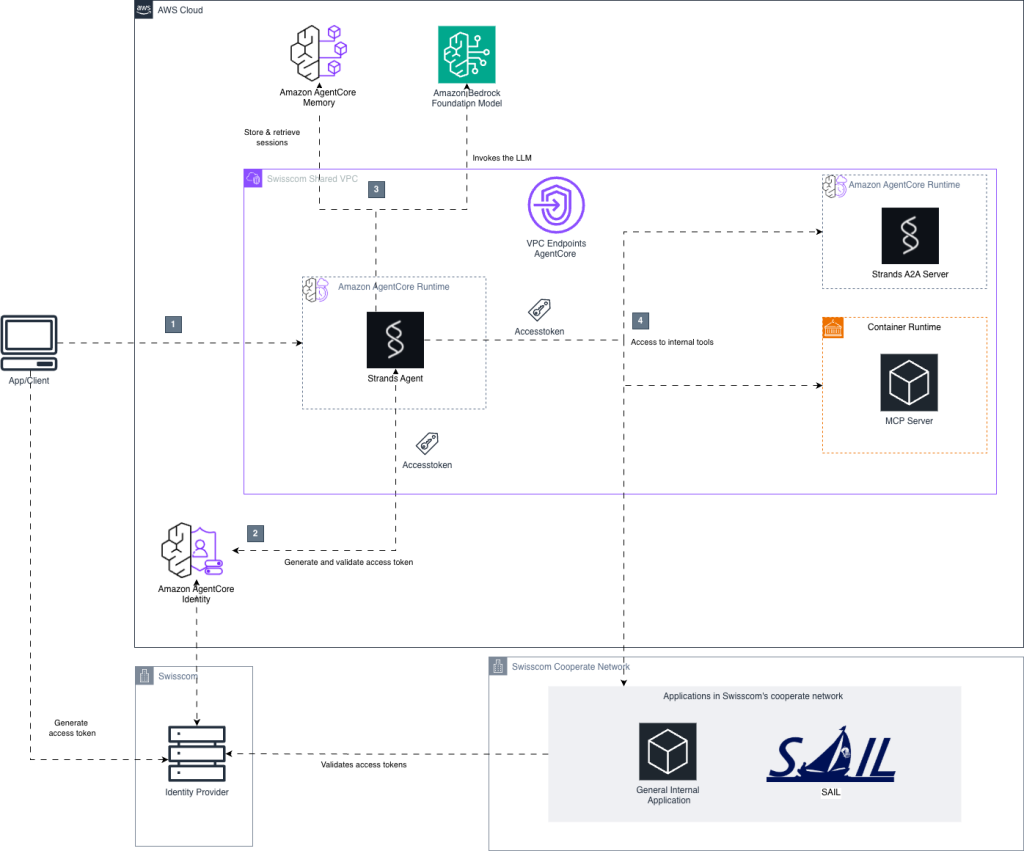
This solution does the following:
- The client sends a request to the Strands agent running on AgentCore Runtime, passing an authentication token from the Swisscom IdP.
- The client’s token is validated and a new token for the agent’s downstream tool usage is generated and passed back to the agent.
- The agent invokes the foundation model on Bedrock and stores the sessions in the AgentCore Memory. The traffic traverses the VPC endpoints for Bedrock and Bedrock AgentCore, keeping the traffic private.
- The agent accesses internal APIs, MCP & A2A servers inside the shared VPC, authenticating with the temporary token from AgentCore Identity.
With the flexibility to use a subset of features of Amazon Bedrock AgentCore and their Amazon VPC integration Swisscom could remain secure and flexible to use the Bedrock AgentCore services for their specific needs, for example to integrate with existing agents on Amazon EKS. Amazon Bedrock AgentCore integrates with VPC to facilitate secure communication between agents and internal resources.
Results and benefits: Real-world implementation with self-service use case
Swisscom partnered with AWS to implement Amazon Bedrock AgentCore for two B2C cases: 1) generating personalized sales pitches, and 2) providing automated customer support for technical issues like self-service troubleshooting. Both agents are being integrated into Swisscom’s existing customer generative AI-powered chatbot system called SAM, necessitating high-performance agent-to-agent communication protocols due to the high volume of Swisscom customers and strict latency requirements. Throughout the development process, the team created an agent for each use case designed to be shared across the organization through MCP and A2A.
Amazon Bedrock AgentCore has proven instrumental in these implementations. By using the Bedrock AgentCore Memory long-term insights Swisscom can track and analyze customer interactions across different touchpoints, continuously improving the customer experience across domains. AgentCore Identity facilitates robust security, implementing precise access controls that limit agents to only those resources authorized for the specific customer interaction. The scalability of AgentCore Runtime allows these agents to efficiently handle thousands of requests per month each, maintaining low latency while optimizing costs.
The adoption of Strands Agents framework has been particularly valuable in this journey:
- Development teams achieved their first business stakeholder demos within 3-4 weeks, despite having no prior experience with Strands Agents.
- One project team migrated from their LangGraph implementation to Strands Agents, citing reduced complexity and faster development cycles.
- The framework’s native OpenTelemetry integration supported seamless export of performance traces to Swisscom’s existing observability infrastructure, maintaining consistency with enterprise-wide monitoring standards.
- The Strands evaluation test cases allowed teams quickly put an evaluation pipeline together without the need of additional tools, for a quick validation of the PoC.
Conclusion: Enterprise AI at scale – Key insights and Strategic implications
Swisscom’s implementation of Amazon Bedrock AgentCore demonstrates how enterprises can successfully navigate the complexities of production-ready Agentic AI while maintaining regulatory compliance and operational excellence. Swisscom’s journey offers 3 critical insights:
- Architectural foundation matters: By addressing the fundamental challenges of secure cross-org authentication, standardized agent orchestration, and comprehensive observability, Swisscom established a scalable foundation that accelerates deployment rather than constraining it. The integration of AgentCore Runtime, Identity, and Memory services accelerated the infrastructure setup so teams could focus on business value.
- Framework selection drives velocity: The adoption of Strands Agents framework exemplifies how the right development tools can dramatically reduce time-to-value. Teams achieving stakeholder demos within 3-4 weeks, coupled with successful migrations from alternative frameworks, validates the importance of developer experience in enterprise AI adoption.
- Compliance as an enabler: Swisscom proved that regulatory compliance need not impede innovation. The system’s ability to scale while maintaining data sovereignty and user privacy has proven particularly valuable in the Swiss industry, where regulatory compliance is paramount.
As enterprises increasingly recognize AI agents as fundamental to competitive advantage, Swisscom’s implementation provides a proven reference architecture. Their success with high-volume B2C applications—from personalized sales assistance to automated technical support—illustrates that agentic AI can deliver measurable business outcomes at scale when built on appropriate infrastructure. This implementation serves as a blueprint for organizations seeking to deploy enterprise-scale AI solutions, showing how careful architectural planning and the right technology choices can lead to successful outcomes in both customer service and sales operations.
Next steps and looking ahead
The future roadmap focuses on three key areas: agent sharing, cross-domain integration, and governance. A centralized agent registry will facilitate discovery and reuse across the organization, supported by standardized documentation and shared best practices. Cross-domain integration will enable seamless collaboration between different business units, with clear standards for agent communication and interoperability. The implementation of robust governance mechanisms, including version control, usage monitoring, and regular security audits, will facilitate sustainable growth of the system while maintaining compliance with enterprise standards. This comprehensive approach will help drive continuous improvement based on real-world usage patterns and feedback.
Check out these additional links for relevant Agentic related information:
About the authors
 Arun Sittampalam, Director of Product Management AI at Swisscom, leads the company’s transformation toward Agentic AI, designing frameworks that scale large language model (LLM)–driven agents across enterprise environments. His team is building Swisscom’s agentic platform, integrating Amazon Bedrock, AgentCore and internal orchestration frameworks to empower Swisscom’s AI product teams to build and scale intelligent agents faster. Arun focuses on operationalizing multi-agent architectures that deliver automation, reliability, and scalability.
 Maxime is a System and Security Architect at Swisscom, responsible for the architecture of Conversational and Agentic AI enablement. He is originally a Data Scientist with 10 years of experience in developing, deploying and maintaining NLP solutions which have been helping millions of Swisscom customers.
 Julian Grüber is a Data Science Consultant at Amazon Web Services. He partners with strategic customers to scale GenAI solutions that unlock business value, working at both the use case and enterprise architecture level. Drawing on his background in applied mathematics, machine learning, business, and cloud infrastructure, Julian bridges technical depth with business outcomes to address complex AI/ML challenges.
 Marco Fischer is a Senior Solutions Architect at Amazon Web Services. He works with leading telecom operators to design and deploy scalable, production-ready solutions. With over two decades of experience spanning software engineering, architecture, and cloud infrastructure, Marco combines deep technical expertise with a passion for solving complex enterprise challenges.
 Akarsha Sehwag is a Generative AI Data Scientist for Amazon Bedrock AgentCore GTM team. With over six years of expertise in AI/ML, she has built production-ready enterprise solutions across diverse customer segments in Generative AI, Deep Learning and Computer Vision domains. Outside of work, she likes to hike, bike or play Badminton.
 Ruben Merz is a Principal Solutions Architect at AWS, specializing in digital sovereignty, AI, and networking solutions for enterprise customers. With deep expertise in distributed systems and networking, he architects secure, compliant cloud solutions that help organizations navigate complex regulatory requirements while accelerating their digital transformation journeys.