

Translated by
Nazia BIBI KEENOO
Published
October 7, 2025
The Golden Goose Arena has opened in Milan: a true temple to padel within CityLife Park, created in collaboration with the luxury sneaker brand and featuring nine courts, lounge areas, and retail spaces, totaling more than 3,000 square meters. “The project required an eight-figure investment,” explained Silvio Campara, CEO of Golden Goose, during the opening ceremony.

The 2,800-square-meter sports area includes six premium all-black indoor courts, an immersive pro court equipped with tracking cameras and an LED scoreboard, and two vintage-style outdoor courts. Complementing the arena is a store dedicated to Golden Goose’s Star line, with product personalization and lounge areas spanning 1,000 square meters.
“The Arena is a place where the community interacts with the brand. We need to create value, not just make money. Initiatives do not always have to deliver a financial return; our goal is the common good,” Campara said. The project taps into the padel trend, a phenomenon in full swing “with 39 million players, up 158% year on year, and played by many women,” recalled the CEO of Golden Goose, the only sneaker brand with 70% female customers. There is also a social focus. “It is the first padel stadium in the world accessible to people with disabilities. There is also an area open to the public, featuring a restaurant and a playground. The outdoor area with the permanent kiosk is expected to be operational by November. We expect more than 40,000 visitors,” said Campara.

“We have invested significant resources in this project. It is the largest recreational area in Milan. The concept has attracted the attention of major investors in America, Europe and China,” Campara continued. On the sidelines of the conference, he also commented on rumors that funds are front-runners to acquire the Permira-controlled brand. “We are the only direct-to-consumer brand growing at double digits. It’s natural to be in the spotlight. The 2025 financial year will close on a positive note, continuing the trend of 2024,” Campara added.
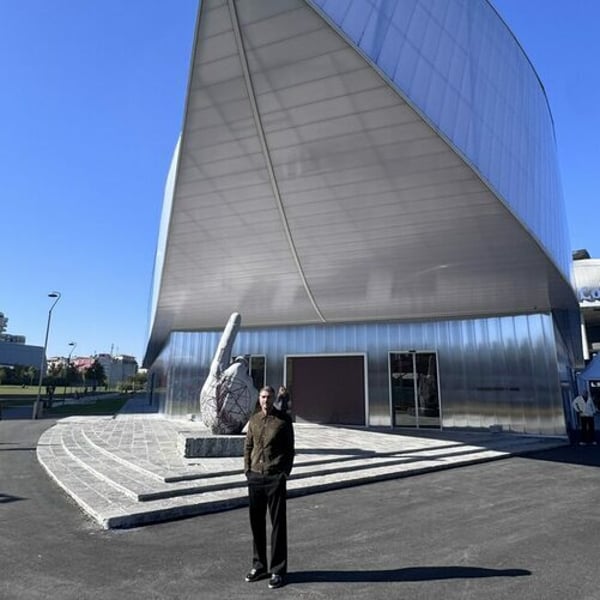
A hand-shaped sculpture by Fabio Viale dominates the arena’s entrance, its finger pointing skyward. Architect Fabio Novembre, who oversaw the project, explained: “It is the same hand as the Colossus of Constantine, but tattooed, it becomes the symbol of the arena.” He described padel as “an inclusive and democratic sport, practiced equally by men and women.” With its translucent façades, the arena acts as a lantern that illuminates the park at night. Novembre emphasized the structure’s flexibility, noting that workers can dismantle it in two days without pouring any concrete.
Former AC Milan star and avid padel enthusiast Demetrio Albertini guided the arena’s creation. He spotted the sport’s boom in Rome and, together with his friend Lorenzo Alfieri, founded City Padel, the company that manages the new facility. “In Milan, there were only four padel courts. In 2017, we set out to promote the CityLife area through this sport, which brings people together and is accessible to everyone. A successful sport always has two components: competition and enjoyment,” said Albertini.

“I’m impressed by the quality of this project. I’ve never played padel, but I have played squash, which I had some brief success with. Padel, on the other hand, is now well established in Milan. The municipality has 16 courts (with a further 70 under concession), while private operators have about 300. That brings Milan to 400 padel courts. This space is not just for sport; it enhances the sense of community. It attracts people, creates jobs and benefits the city as a whole,” said Beppe Sala, mayor of Milan.
A partnership with Atlante will power the arena with a 150-kilowatt photovoltaic system to supply all daytime energy needs. In the second phase, the team will install a battery storage unit to capture surplus energy for evening use, enabling the arena to operate fully self-sufficiently around the clock.
Profits generated by the Golden Goose Arena will be reinvested in outlying neighborhoods in cooperation with the city government.
This article is an automatic translation.
Click here to read the original article.
Copyright © 2025 FashionNetwork.com All rights reserved.