



Ivanti Endpoint Manager (“EPM”) versions 2024 SU4 and below are vulnerable to stored cross-site scripting (“XSS”). The vulnerability, tracked as CVE-2025-10573 and assigned a CVSS score of 9.6, was patched on December 9, 2025 with the release of Ivanti EPM version EPM 2024 SU4 SR1. An attacker with unauthenticated access to the primary EPM web service can join fake managed endpoints to the EPM server in order to poison the administrator web dashboard with malicious JavaScript. When an Ivanti EPM administrator views one of the poisoned dashboard interfaces during normal usage, that passive user interaction will trigger client-side JavaScript execution, resulting in the attacker gaining control of the administrator’s session.
An authenticated check for CVE-2025-10573 will be made available to Exposure Command, InsightVM and Nexpose customers in the December 9, 2025 content release. Due to the unauthenticated nature of this vulnerability, customers are recommended to patch affected instances as soon as possible.
Product description
Ivanti EPM is endpoint management software used by many organizations for remote administration, vulnerability scanning, and compliance management of user endpoints, among other use cases. An authenticated EPM administrator can remotely control endpoints and install software on systems managed by the EPM server, making it a desirable target for attackers.
Credit
This vulnerability was discovered and reported to the Ivanti team by Ryan Emmons, Staff Security Researcher at Rapid7. The vulnerabilities are being disclosed in accordance with Rapid7’s vulnerability disclosure policy. Rapid7 is grateful to the Ivanti team for their assistance and collaboration.
Vulnerability details
The testing target was an Ivanti EPM 11.0.6 Core installation on Windows Server 2022. Rapid7 identified one high severity vulnerability, stored cross-site scripting, while researching Ivanti EPM. Based on information provided by the vendor, it affects versions below EPM 2024 SU4 SR1.
Ivanti EPM provides an ‘incomingdata’ web API that consumes device scan data. An unauthenticated attacker can submit device scan data containing malicious cross-site scripting (“XSS”) payloads. The submitted scan is then automatically processed and unsafely embedded in the web dashboard, facilitating arbitrary client-side JavaScript code execution.
The ‘incomingdata’ web API is configured to execute a CGI binary, postcgi.exe, which writes device scan files to a processing directory outside of the web root. These device scan files are of a simple key=value format. An example malicious device scan request, which is a normal scan request with double quotes and a JavaScript injection in various fields, is depicted below.
POST /incomingdata/postcgi.exe?prefix=ldscan&suffix=.scn&name=scan HTTP/1.1
Host: 192.168.154.132
Sec-Ch-Ua: "Not?A_Brand";v="99", "Chromium";v="130"
Sec-Ch-Ua-Mobile: ?0
Sec-Ch-Ua-Platform: "Windows"
Accept-Language: en-US,en;q=0.9
Upgrade-Insecure-Requests: 1
User-Agent: Mozilla/5.0 (Windows NT 10.0; Win64; x64) AppleWebKit/537.36 (KHTML, like Gecko) Chrome/130.0.6723.70 Safari/537.36
Sec-Fetch-Site: none
Sec-Fetch-Mode: navigate
Sec-Fetch-User: ?1
Sec-Fetch-Dest: document
Accept-Encoding: gzip, deflate, br
Priority: u=0, i
Connection: keep-alive
Content-Type: text/plain
Content-Length: 916
Device ID =INJECT"
Hardware ID =C492A2E9-842A-A444-9FDA-AEE64D1C1252
Scan Type =BAREMETAL
Type =Bare Metal Provision
Status =inj
Last Hardware Scan Date =1411369165
Display Name =INJECT"
Agentless =1
Device Name =INJECT"
Network - NIC Address =111111111118
Network - TCPIP - Host Name =INJECT"
OS - Name =INJECT"
LANDesk Management - Inventory - Scanner - Type =Bare Metal Provision
LANDesk Management - Inventory - Scanner - File Name =barescan.exe
Network - TCPIP - Bound Adapter - (Number:0) - Physical Address =111111111117After the malicious request is performed, the device scan file is then subsequently parsed and added to the device database. When an administrator views a web dashboard page that displays device information, the XSS payloads are unsafely embedded in the web browser’s DOM, and the attacker gains control of the administrator’s session. Two example web dashboard payload executions are depicted below.
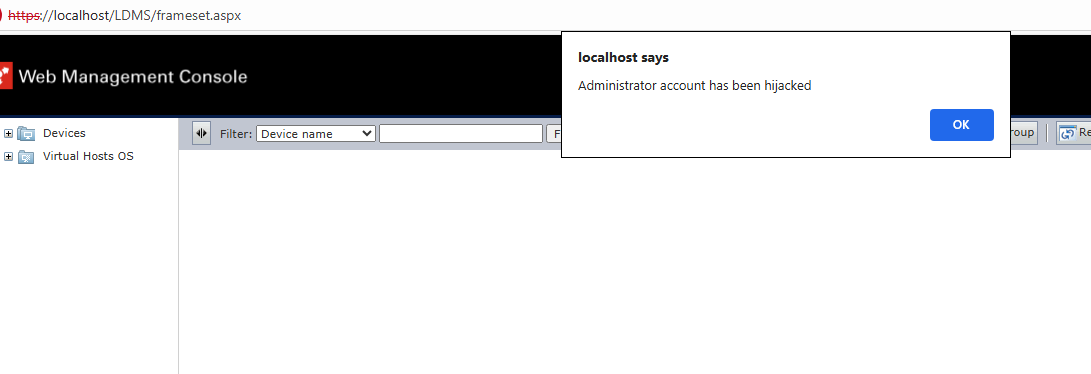
Figure 1: An administrator accesses the poisoned ‘frameset.aspx’ page of the management console
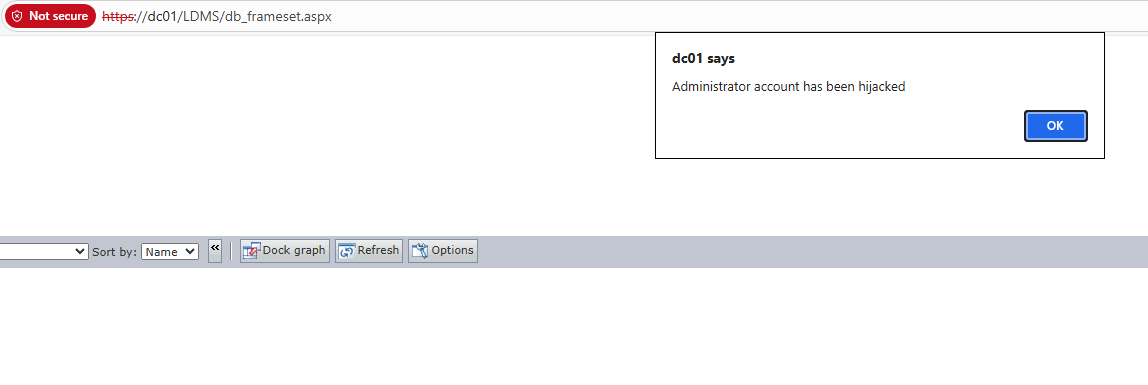
Figure 2: An administrator accesses the poisoned ‘db_frameset.aspx’ page of the management console.
Vendor statement
“Ivanti is dedicated to ensuring the security and integrity of our enterprise software products. We do this by providing security fixes which resolve a vulnerability without impacting the functionality that our customers depend on. We recognize the vital role that security researchers, ethical hackers, and the broader security community play in identifying and reporting vulnerabilities. We appreciate the work that Ryan Emmons, and the entire Rapid7 team, have done in reporting this vulnerability to Ivanti, coordinating disclosure and working with us to help protect our customers.”
Mitigation guidance
Per the vendor, this vulnerability can be remediated by upgrading to Ivanti EPM version EPM 2024 SU4 SR1.
Rapid7 customers
Exposure Command, InsightVM and Nexpose customers will be able to assess their exposure to CVE-2025-10573 with an authenticated vulnerability check expected to be available in the December 9, 2025 content release.
Disclosure timeline
August 15, 2025: Rapid7 contacts Ivanti with vulnerability details.
August 19, 2025: Ivanti confirms receipt and acknowledges that triage has begun.
August 27, 2025: Ivanti states that the vulnerability has been reproduced.
September 9, 2025: Ivanti requests a ~90-day disclosure extension to Nov 11, 2025.
September 16, 2025: Rapid7 accepts the Nov 11, 2025 extension request.
October 31, 2025: Ivanti requests an extension to December 9, due to a patch revision.
November 5, 2025: Rapid7 accepts the new disclosure date of December 9.
December 9, 2025: This disclosure.