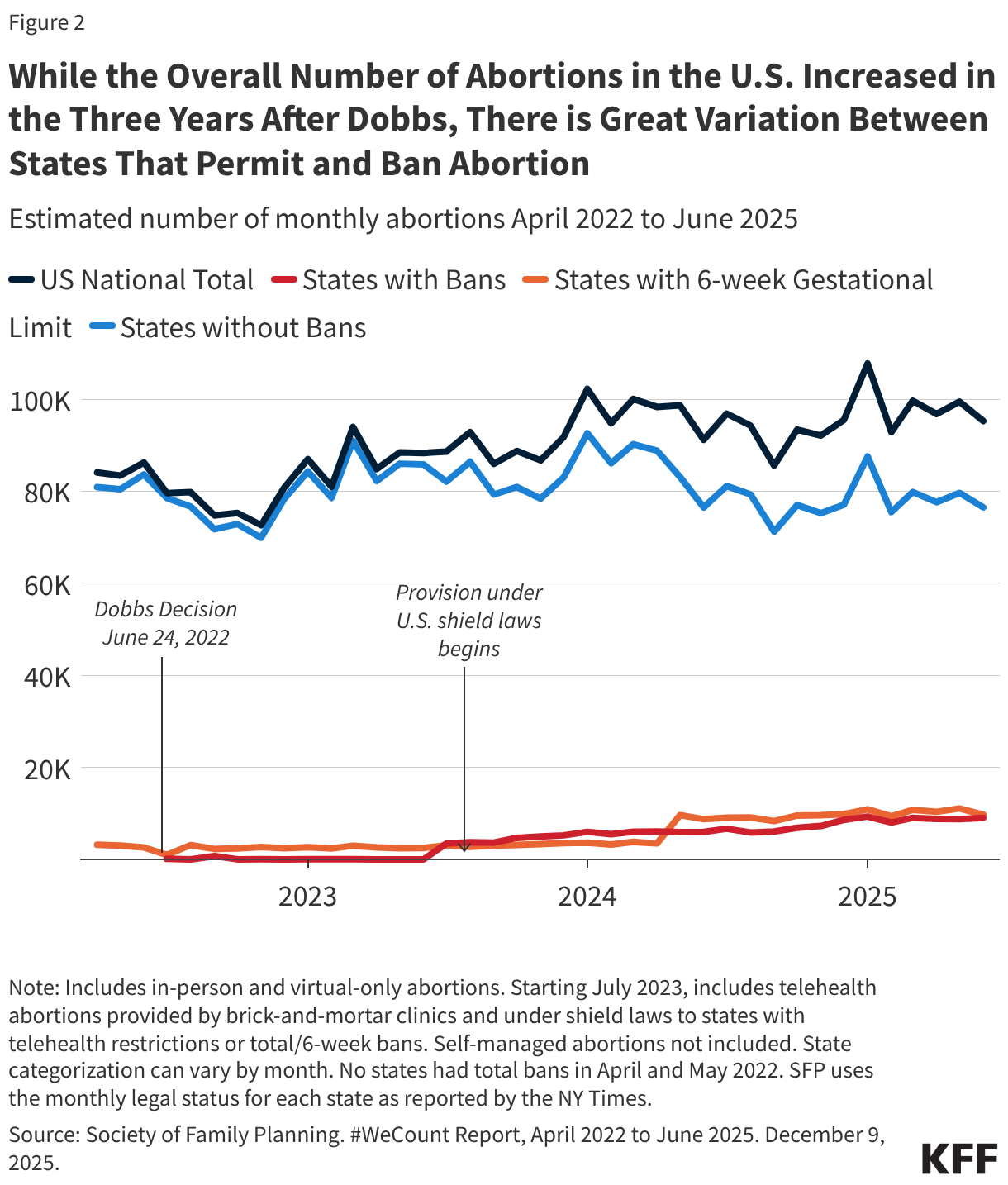



The most recent data estimates that more than one million abortions (1,142,970) occurred in the U.S. in 2024 and there were more than half a million abortions (591,770) in the first six months of 2025.
Three different organizations currently track abortion volume at the state and the federal levels: the federal Centers for Disease Control and Prevention (CDC), the Guttmacher Institute, and the Society for Family Planning (SFP). The CDC has been collecting abortion data for decades, but several states do not provide data to the federal government (reporting to the CDC is voluntary) and there is a two-to-three-year time lag until the data become publicly available.
Since the Dobbs ruling, the Guttmacher Institute’s Monthly Abortion Provision Study and the SFP’s #WeCount have been tracking state level changes in abortion volume based on data provided by abortion clinics and providers. Both studies provide national and state-level estimates on procedural and medication abortions but differ in some methodologic details. The Guttmacher study compares current abortion rates to 2020, while #WeCount compares rates to the months immediately before Dobbs in 2022. Neither source includes data on self-managed abortions, which are abortions that a pregnant person can do on their own by taking medication abortion pills without clinical supervision. For more details about data sources, see KFF’s issue brief on abortion trends.
For most of the decade prior to the Dobbs ruling, there was a steady decline in abortion rates nationally, but there was a slight increase in the years just before the ruling. Immediately following the Dobbs ruling, the number of abortions in the U.S. dropped as more states enforced bans and restrictions.
Paradoxically, the most recent data show that the abortion volume in the U.S. slightly increased overall in the three years following the Dobbs ruling.
The monthly average number of abortions steadily increased from 79,620 monthly abortions in 2022 (April to December 2022), to 88,180 abortions in 2023, to 95,250 abortions in 2024, and to 98,630 in 2025 (January to June 2025). This overall increase in the number of abortions nationally can be largely attributed to the growth of telehealth for medication abortion, increased availability of lower cost medication abortion pills through virtual clinics, and in particular shield law abortions, where clinicians in legal states are mailing pills to individuals residing in states with bans and restrictions. Additionally, in several states without bans, there has been increased interstate travel for abortion access, expanded capacity to see patients, increased measures to protect abortion rights and improve coverage of abortion care for residents and out-of-state patients, and the broader availability of low-cost abortion medication.
However, the small upswing nationally obscures the massive declines in abortion access to in-state providers in states with bans and restrictions as well as the hardships that many pregnant people experience in accessing abortion care. Additionally, there are month-to-month variations in all states, and changes in policy can cause larger shifts. For example, in May 2024 Florida implemented a ban on abortions after six weeks gestation (previously permitted up to 15 weeks), and subsequently there was a noticeable decline in abortions in the state and nationally.